Essay 04 / Comparative case studies
Close readings of worlds
A closed door, an exposed pipe and a familiar stair can each revise a player’s understanding. The important difference is how the world teaches us to read them.
A pair of shoes beside an entrance offers a modest clue: someone uses this threshold as a transition between outside and inside. It does not tell us who they are, whether they remain nearby or why they left. A useful close reading begins with this limited observation and asks how other parts of the world support or complicate it.
The following cases compare three kinds of evidence rather than ranking three games. Gone Home builds knowledge through domestic accumulation. Portal makes a change in architectural register consequential. Dark Souls lets a route become meaningful through the player’s effort and recognition. These readings describe observable structures and our interpretations; they do not claim access to the developers’ private intentions.
Gone Home: the house as a partial archive
Gone Home presents a house whose rooms contain belongings, documents and traces of its residents’ lives. Its domestic scale makes spatial association especially useful. A possession in a personal room, a shared room or a tucked-away space has a different relationship to privacy. The player reads not only the object’s content but the circumstances in which it can be found.
The interpretive temptation is to call the house a transparent record. It is not. An archive is selective, and a household contains different people’s habits of keeping, hiding and discarding. The player encounters material out of its original sequence and must revise early impressions as connections develop. This makes the act of reconsideration central to the experience.
There is also a limit to this example. Written and voiced material performs substantial narrative work. It would be inaccurate to describe the game as a story told entirely without language. Its value for environmental analysis lies in how spatial placement frames those materials and how moving among rooms connects private accounts to a shared domestic setting.
Close reading is not finding the one correct symbol. It is making an interpretation answerable to the space.
Portal: the public system and its underside
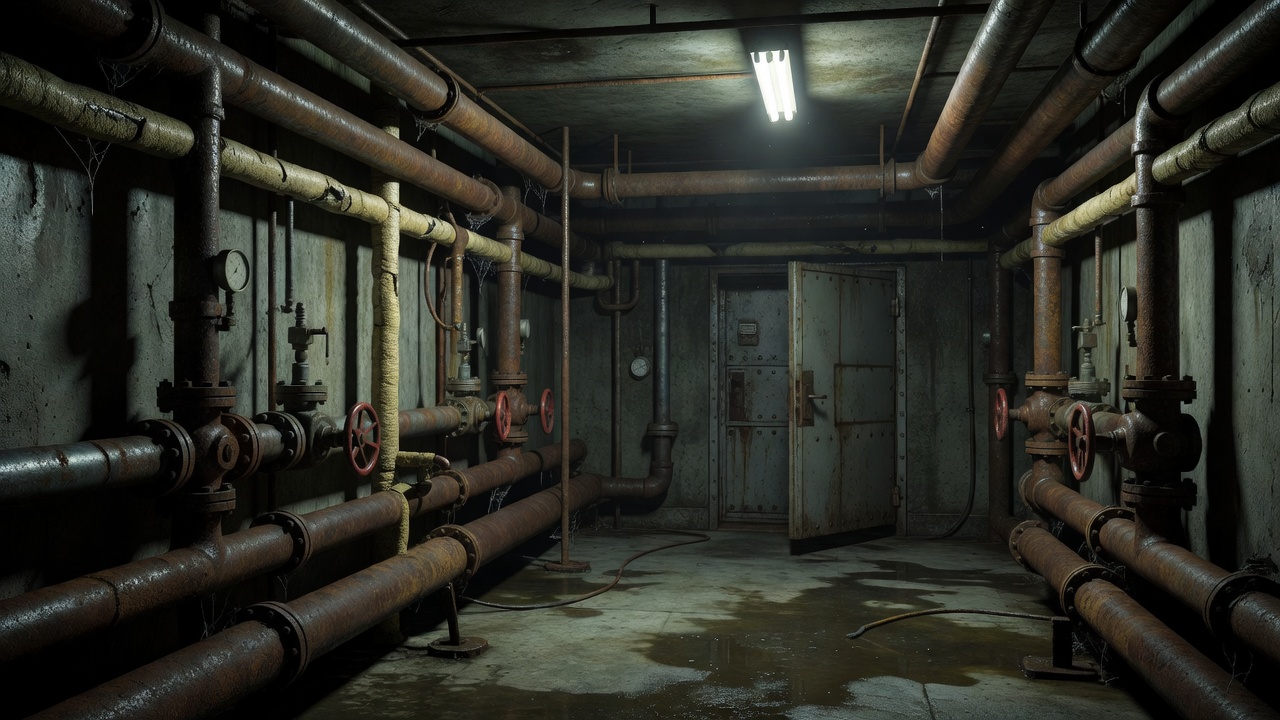
Portal establishes an architectural language of controlled testing: bounded spaces, clean surfaces and equipment organised around tasks. As movement exposes less presentable parts of the facility, the contrast changes the player’s relationship to that apparent order. Working infrastructure reveals that the testing environment is constructed and maintained rather than self-sufficient.
The important evidence is relational. A service space might look ordinary in another game; here it gains significance because the player has learned the test chambers’ visual discipline. Passage between these registers turns an architectural contrast into a change of understanding. The route makes the contradiction available at a consequential moment.
Again, caution improves the reading. Surface disorder does not by itself prove a complete history, and dialogue remains important to Portal’s meaning. The environmental claim is narrower: moving behind the controlled presentation exposes a different account of the same institution. That relationship can be observed without inventing a specific story for every stain or broken panel.
Dark Souls: the route remembered by the body
Dark Souls offers a different emphasis. A newly opened shortcut can connect a difficult journey to a place the player already knows. The discovery is simultaneously geographic and personal: the world’s structure becomes clearer, while a repeated practical burden changes. Recognition carries relief because the player remembers the cost of the longer route.
That cost matters to the interpretation. Looking at a completed map may reveal the same connection, but it does not reproduce the sequence of uncertainty, traversal and recognition. The player’s history supplies part of the evidence. The place communicates through the difference between an earlier, incomplete understanding and a later, usable one.
Not every shortcut should therefore be called a hidden plot. Its strongest narrative contribution may be a change in perceived scale or the feeling of becoming less alien to a hostile world. Naming that contribution precisely is more useful than attaching speculative lore to the door itself. Movement can tell a story about learning without explaining the world’s entire past.
Carry the comparison into another world
Try the same distinctions in Tacoma’s station, Prey’s Talos I, the island of The Witness or the inhabited interiors of What Remains of Edith Finch. Ask whether the crucial relationship lies between objects, between areas or between the world and the player’s remembered actions. Several modes can operate together, but identifying the dominant one gives your analysis a clear centre.
Henry Jenkins’s essay “Game Design as Narrative Architecture” offers a useful theoretical starting point for thinking about spatially organised narrative possibilities. Kevin Lynch’s The Image of the City supplies another lens through paths, edges, districts, nodes and landmarks. Neither reference is a universal decoding key. Treat each as a vocabulary that helps formulate questions, then return to the particular game for evidence.
Sources and reading paths
- Gone Home — official site.
- Portal — official series site.
- Dark Souls Remastered — publisher overview.
- Tacoma — official site.
- Prey — publisher overview.
- The Witness — developer site.
- What Remains of Edith Finch — developer overview.
- Henry Jenkins, “Game Design as Narrative Architecture”.
- Kevin Lynch, The Image of the City — MIT Press.